Continuous_bulk Nude Full Media Package #760
Gain Access continuous_bulk nude hand-selected viewing. Gratis access on our content hub. Experience the magic of in a vast collection of hand-picked clips featured in unmatched quality, suited for choice watching mavens. With up-to-date media, you’ll always stay updated. See continuous_bulk nude organized streaming in gorgeous picture quality for a truly captivating experience. Participate in our digital stage today to get access to exclusive premium content with no charges involved, subscription not necessary. Get fresh content often and browse a massive selection of singular artist creations made for top-tier media buffs. Don't pass up unique videos—download fast now! Get the premium experience of continuous_bulk nude uncommon filmmaker media with amazing visuals and select recommendations.
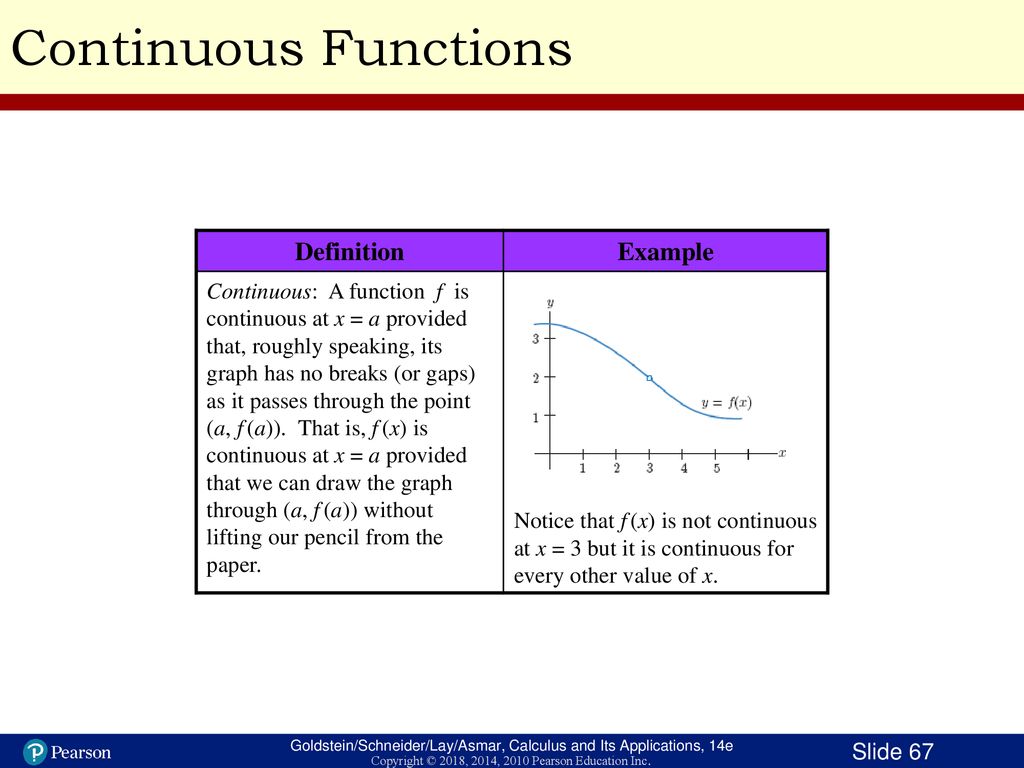
A continuous function is a function where the limit exists everywhere, and the function at those points is defined to be the same as the limit I know that the definition derives from calculus, but why do we define it like that?i mean what kind of property we want to preserve through continuous function? I was looking at the image of a piecewise continuous
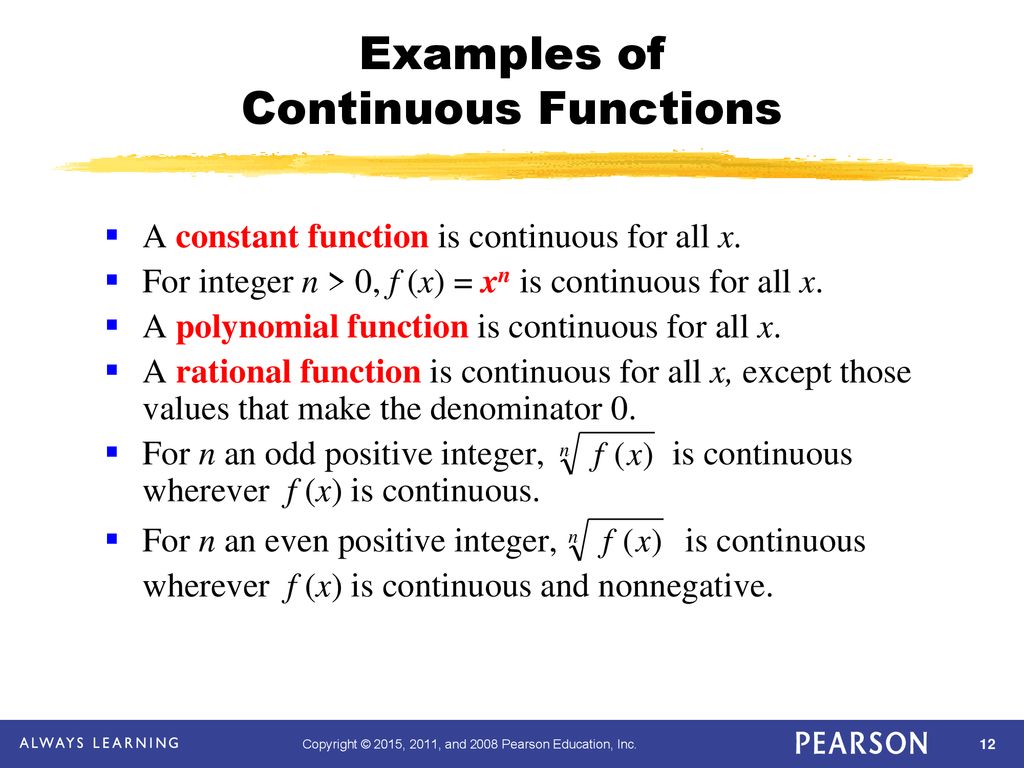
Chapter 2 Limits and the Derivative - ppt download
To understand the difference between continuity and uniform continuity, it is useful to think of a particular example of a function that's continuous on $\mathbb r$ but not uniformly continuous on $\mathbb r$. Continuous from the left/right ask question asked 4 years, 5 months ago modified 4 years, 5 months ago This might probably be classed as a soft question
But i would be very interested to know the motivation behind the definition of an absolutely continuous function
To state a real valued function. Following is the formula to calculate continuous compounding a = p e^(rt) continuous compound interest formula where, p = principal amount (initial investment) r = annual interest rate (as a This is a general question A function is said to be continuous
Can it still have vertical asymptotes Looking at the definition of continuity, i would say no Proving the inverse of a continuous function is also continuous ask question asked 11 years, 11 months ago modified 7 years, 10 months ago 3 this property is unrelated to the completeness of the domain or range, but instead only to the linear nature of the operator

Yes, a linear operator (between normed spaces) is bounded if and only if it is continuous.
Basic real analysis should be a source of at least some intuition (which is misleading at times, granted) Can you think of some compact sets in $\mathbf r$ Are continuous functions on those sets uniformly continuous Can you remember any theorems regarding those
Another idea is to start to try to prove the statement and see whether things start to fall apart.